Ontoledgy AI Ontology Context Library · why this exists
Meaning is an engineering problem
An AI's answer is the product of two things: the generator and the context you feed it. The generator keeps improving on its own. The context is the half you own, and it is where most answers are won or lost. Context engineering is the craft of assembling it, and its hard part was never wording the prompt. The hard part is the meaning underneath: most context is built on data that machines have stored but never understood.
That missing meaning didn't vanish. It stayed in people's heads and working practices, so each system tells its own story, disagrees with the others and won't interoperate: a Tower of Babel in data form. Feed that to a fluent AI and it inherits every contradiction, with no firm ground to stand on and nothing to be sense-checked against. Context isn't a prompt you write once. It is an engineering problem, and the answer is to make meaning explicit, shared and grounded. This page is the problem. The rest of the library is the fix.
01context can't speak without meaning02that meaning is trapped in people03systems disagree · can't interoperate04ungrounded AI can't be trusted or checked
01
The model only sees the context, and the context can't speak
An LLM knows nothing but the context you give it: whatever isn't in that window doesn't exist for the model. So context engineering comes down to one question: what do you put in, and does it carry its own meaning? Reach for your data and you hit the wall at once. We told ourselves the hard part was done when the data was in the computer. But that only ever answered where the information lives, never what it is about. A database can hold a million invoices and still not know that two of them name the same company. It shuffles the symbols flawlessly without grasping what any of them stand for. Holding a symbol is not understanding it, and a symbol with no meaning is context that can't speak.
What the system stores
Bytes it can hold
CUST_4471 · 2024-03-14 · 18,200.00 · status=2
Held, copied, sorted and summed at no cost. The machine is fluent in the structure (rows, keys, totals), and that fluency is real.
What it never stored
What any of it means
That CUST_4471 is Acme Holdings, a strategic account; that status=2 means overdue; that this is the third late payment in a row, a churn signal someone should act on.
None of that is in the data. It lives in a person's head. The machine has the bytes and none of the meaning.
02
The meaning lives in people, not the system
The meaning isn't lost. It just isn't written down anywhere a machine can read, so it can never be loaded into a context window. It lives as implicit knowledge in the people who run the system, and in working practices handed from desk to desk. The system "works" only because a human quietly supplies the half that was never recorded. Engineer context out of this data and you ship the bytes and leave the meaning behind. When that person leaves, the meaning leaves with them.
Foreign keys everyone understands but nobody declared: the joins live in habit, not in the schema.
A column called flag that means three different things depending on which team filled it in.
The rule that you always exclude region 9 from the totals: known at the desk, written nowhere.
Two tables you must never join directly, and the one analyst who remembers why is retiring in March.
Every one of these is meaning the machine can't see. The data leans on a running commentary that no system holds and no system enforces. That's not a quirk of one badly run database. It's the normal state of almost all enterprise data.
03
Every system speaks its own language
Pull context from more than one system and it doesn't add up. It contradicts. Each system carries its own private, unwritten model, so no two of them agree. The same real thing turns up under a different name, a different key and a different shape, and nothing tells them they are the same thing. Stuff that into a context window and you don't get a fuller picture. You stack the contradictions.
One company · three systems · no shared key
CRM
Acme Holdings Ltd
id · C-4471
Billing
ACME HLDGS
acct · 88231
Legal-entity DB
Acme Holdings (UK) Limited
lei · 549300XYZ…
One company, three records, and not a single key in common. Integration moves the data between systems; it does nothing to reconcile what the data means. Many tongues and no shared language: the data version of the Tower of Babel. Reports don't tie out, the same customer is counted twice, and every new system added to the pile makes the confusion worse, not better.
04
Then we point an AI at the pile
The new move is to lay a large language model over all of this and call it context. But a fluent model inherits every inconsistency beneath it and invents to fill the gaps. Because nothing was ever made explicit, there is no firm ground for it to stand on and nothing to sense-check it against. Ungrounded context doesn't just limit the AI. It makes the AI confidently wrong.
It can't operate reliably
Plausible, ungrounded
An LLM predicts the next likely word, not the true one. Sat on data that disagrees with itself, a confident invention and a fact read exactly the same.
Ask the same question twice and get two answers, each delivered with the same certainty. There is no stable ground underneath to hold it steady.
It can't be sense-checked
Nothing to check it against
To grade a claim true or false you need a shared, explicit theory of the world to test it against. The data never had one; the meaning stayed implicit.
So there is no common criterion to hold the model to. A fluent AI with nothing to be checked against is confident and unaccountable in equal measure.
Both failures trace back to the same hole as everything above: the meaning was never made explicit or shared. Supply that, and an AI can finally be grounded and graded.
05
Engineer the foundations, and the context holds
Couldn't you just describe all this in plain language, as a pile of definitions and notes, and let the model work out the rest? It doesn't hold. Natural language alone can't carry the meaning. Prose is where the ambiguity lives, not where it gets resolved: the same word still means three things, and no amount of description tells the model that two records are one company. It's expensive, too. Re-narrating the world in every prompt burns the context budget you needed for the task, and a longer, looser description is a less reliable one, not a fuller one. Meaning has to be made explicit and structured, not merely narrated: succinct enough to fit the window, precise enough to act on, and shared so that every system, and the model, reads it the same way.
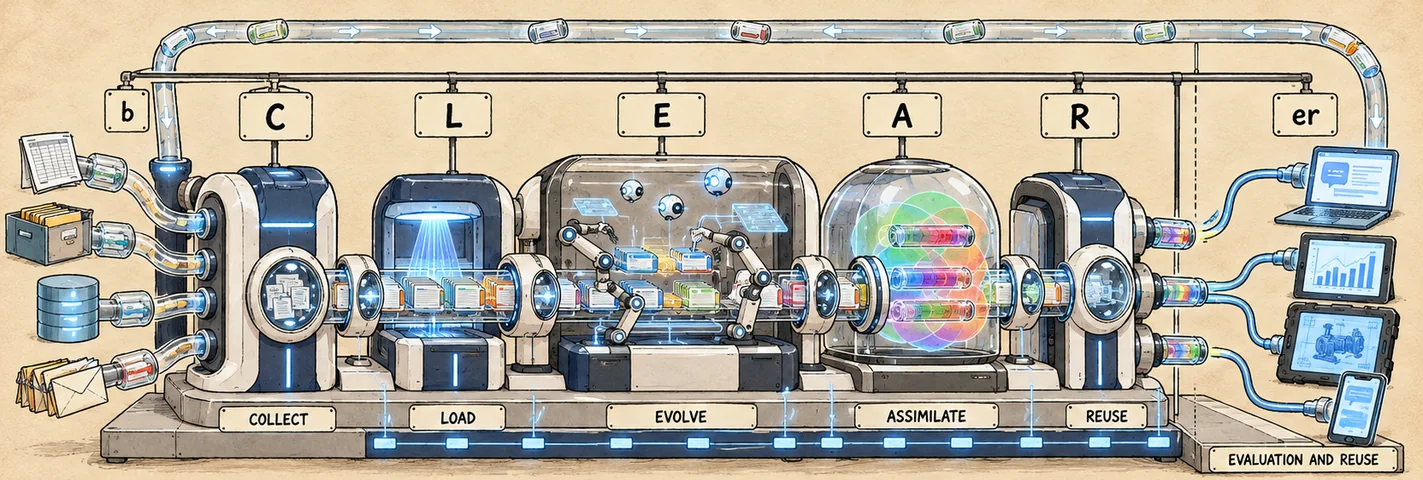
The bCLEARer engine: connect records and schema to what they represent through an explicit, tested model.
Follow every failure back and it ends in the same place: the meaning was never made explicit. The context that can't speak, the knowledge trapped in people, the systems that won't agree, the AI that can't be trusted: all of it is context built on data that doesn't know what it is about. Engineering context meaningfully means giving it stable foundations. Make the meaning explicit and shared, anchor it in an ontology of what actually exists, and pin every thing to a deterministic identity so that two records of one company are known to be one. Carry meaning from the data we hold to the world it refers to, and the context finally holds. That is what this library builds.
The library is open and free to read. If you are working on the same problem, carrying meaning from the data you hold to the world it is about, leave your email and we will get in touch. No campaign, no drip sequence: a real conversation about what you are building.
Episode 0 Why
Part 1 Modelling the Data
Part 2 From Words to the WorldComing soon
Part 3 The Semantic PipelineComing soon
Part 4 Grounding the GeneratorComing soon
Part 5 Putting It All TogetherComing soon
Coming soon · planned chapter.
Continue · part 1 of 5
Modelling the Data
Start where every business already is: disparate systems, each modelling the same world its own way. See why a definition alone can't carry meaning between them — and what has to replace it.
The identifier text “P-101” is not the metal plate. The plate is not the tagged functional object either.
Two pumps, two installed periods
Each pump has a history before fitting and after removal. Only the installed temporal portion contributes to the tagged functional object in this model.
Martin F. the computer scientistData side
Martin F. · the computer scientist
Builds the records, mappings, pipelines and tests.
How the model connects
A schema describes storage structure: tables, fields and their arrangement. An ontology models what exists and how things relate through identity and time. It can describe a schema as a data-side artefact; it is not a fancy name for a data model. Mappings and evidence still need to be established and tested.
Richard F. the 4D ontologistWorld side
Richard F. · the 4D ontologist
Models identity, temporal structure and shared foundations across domains.
“An ontology is NOT a schema. That’s a data-side artefact, Martin!”
A schema describes storage structure. An ontology models what exists and how things relate; it can describe the schema as one data-side artefact. It is not a fancy name for a data model.
DL-1000 · Possible-world analyser
Explore an alternative scenario and its assumptions. Inspired by David Lewis’s possible-world semantics, the fictional analyser compares what would follow in a scenario with the evidence for the actual case. It is a way to examine alternatives, not a truth detector or a portal for physical travel.
GR-25 · Euler set kit
Examine set relations using Gergonne’s distinctions. For two non-empty sets, compare equality, proper inclusion in either direction, overlap or disjointness. Handle empty sets explicitly instead of forcing them into the five-way picture.
AE-900 · Spacetime goggles
See an object’s history and temporal parts in the 4D model. Inspired by Einstein’s spacetime ideas, the fictional goggles help distinguish what persists from what is replaced. Relativity is an inspiration for the visual metaphor, not proof of this modelling approach.